
Search engine optimization (SEO) is essential for your site’s visibility and performance. However, not all SEO techniques are created equal, and not all are beneficial. Relying on outdated or plain old bad SEO practices can severely harm your rankings on search engine results pages (SERPs). The good news is that you can utilize many excellent SEO tactics to combat the bad ones and keep your site at its healthiest. Our Fort Lauderdale digital marketing firm shares more on avoiding bad and outdated SEO practices and how to introduce better alternatives to your strategy.
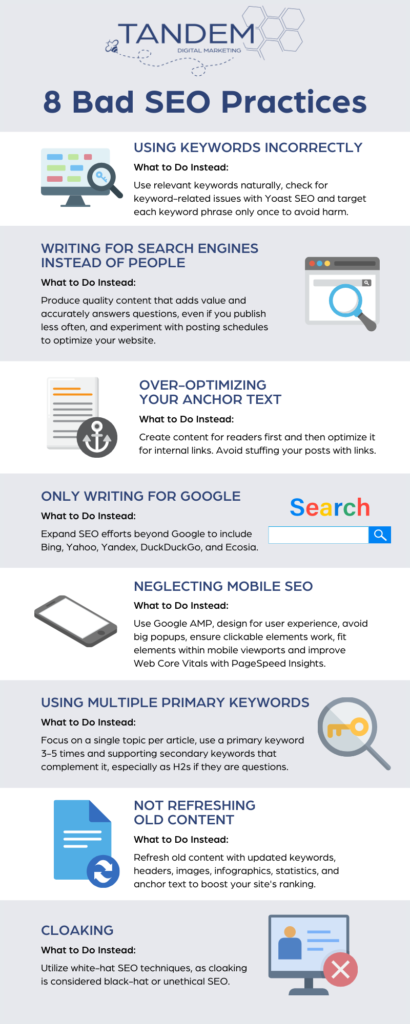
8 Bad SEO Practices & What To Do Instead
SEO can make your website soar above the competition – when implemented correctly, of course. With this in mind, Tandem Buzz shares eight bad and outdated SEO tactics to avoid and what you can do instead.
 Using Keywords Incorrectly
Keywords are essential to effective SEO. These words and phrases help users find your content when they search for relevant terms in search engines like Google and Bing. White-hat SEO strategies like conducting keyword research and using long-tail keywords in the content are useful. However, using a bad SEO keyword strategy can negatively impact your site’s rankings and user experience.
For instance, keyword stuffing is one of the most common outdated SEO tactics. It refers to stuffing or adding as many keywords in your content as possible in an attempt to rank high on SERPs. However, keyword stuffing tends to incorporate keywords that are irrelevant and unnatural and can make it seem as if you’re reading the same sentence written in ten different ways.
Search intent is more important than the number of keywords you use in your content. Not only can keyword stuffing and misusing keywords decrease your rankings in search engines, but these engines are smart enough to identify this tactic as black-hat SEO and penalize your site for using it. On top of that, designing content solely around keywords can also miss the mark when it comes to search intent and can fail to keep users on your site.
What to Do Instead: Aim to use relevant keywords occasionally and naturally throughout your content. You can also use a plug-in, like Yoast SEO, to highlight any keyword-related problems you should change. Additionally, remember to only target keyword phrases once in your content. Focusing on the same phrase multiple times (aside from a primary keyword) can do more harm than good.
Writing for Search Engines Instead of People
It can be easy to get carried away with trying to optimize your content according to Google’s Webmaster Guidelines and forget that you’re writing to offer information to readers. You might focus too much on keyword research and dedicate less time to your writing skills and writing content that flows and makes sense. This approach can end up reducing the value of your content, hurting your SEO over time.
You must also consider how often you post content. For instance, the SEO value of your site will likely plummet if you post new content on your site every day for the purpose of SEO. Search engines want to bring users to the most valuable and high-quality content that’s available. It can be difficult to create high-value content when you’re trying to check off boxes and post every day merely for the sake of posting.
What to Do Instead: Focus on consistently producing content that adds value to your readers and accurately answers their questions. This might mean publishing fewer pieces of content, though these will be better written, a few times a week or even once every two weeks. It’s also important to experiment with different posting schedules to determine what works best for your website.
Over-Optimizing Your Anchor Text
Anchor text is a word or phrase that has a web link to other content. A solid internal linking strategy uses anchor text that has relevant keywords and variations to whatever the attached URL directs to. An old practice was to link only to exact keywords within content, but search engines can quickly recognize this as over-optimized internal linking.
If you’re trying to fit in anchor text by sacrificing the fluidity and accuracy of your content, Google will likely give you a lower ranking. Similarly, including links to unrelated posts simply to have anchor text could also negatively impact your site’s rankings.
What to Do Instead: Instead of over-optimizing your anchor text, write your content with your readers in mind first, and then figure out how you can optimize it for internal links. Consider how you can use internal linking to further help your readers find the information they’re looking for. However, avoid stuffing your posts with links. A good average ranges from 3 to 5 internal links per post, depending on the word count.
Only Writing for Google
Since the dawn of time (or so it seems), most people have focused on writing for Google. Since it’s the most popular search engine out there, this approach is understandable. However, writing for one search engine when there are several others out there can mean you miss out on additional site traffic.
What to Do Instead: Instead of solely focusing your SEO efforts on Google, other search engines you can write for include Bing, Yahoo, Yandex, DuckDuckGo, and Ecosia. If you’re just starting, we suggest focusing on Bing first and then working your way down the list. Bing also offers optimization opportunities for images, social media presence, and registering your business on Bing Places.
Neglecting Mobile SEO
Considering that more than half of online searches come from mobile devices, neglecting SEO optimization for mobile can be detrimental to your website’s rankings.1 For this reason, focusing solely on desktop performance and leaving out mobile performance is a bad SEO practice that needs to be thrown out the window.
What to Do Instead: Some mobile SEO best practices our South Florida marketing agency recommends include:
- Use Google AMP to create a mobile-friendly website
- Avoid big popups on mobile devices
- Design for user experience
- Make sure that “clickable” elements work properly
- Make sure elements on your site aren’t too wide for mobile viewports
- Use PageSpeed Insights to check your Web Core Vitals and how you can optimize them for mobile
Using Multiple Primary Keywords
A good SEO practice is to focus on a primary keyword (basically, the one you want your content to be focused on) and use secondary keywords to support it. However, many writers make the mistake of targeting multiple keywords and their synonyms in one post, over-stuffing their content to the point where it sounds unnatural.
If you’re cramming too many keyword phrases into your content, you’re likely sacrificing how natural and accurate it is for the sake of ranking. Plus, you dilute the search intent and usefulness of your content, which is the purpose of writing it in the first place. Additionally, attempting to cover multiple (although related) topics in one post can also make the entire piece lose focus.
Search engines don’t like this, and neither do users. Both are smart enough to realize when an article is trying to fit in as many keywords and related topics as possible, it can be exactly what a person isn’t looking for.
What to Do Instead: Instead, we recommend focusing on one topic per article. We also recommend using a primary keyword that you can mention 3 to 5 times within your content. Secondary keywords or any supporting keyword phrases should complement the primary keyword. These are especially useful if they’re questions that you can use as H2s.
Not Refreshing Old Content
Another bad SEO practice is forgetting about old content. Especially if your website has been around for a few years, you’re likely to have old content with good potential but a bit outdated SEO-wise. While it’s easy to push old content to the back burner, it’s important to keep as much of your website content as relevant as possible.
What to Do Instead: A great way to improve site rankings is to refresh old articles and service pages to improve your rankings and ensure your content is relevant. You can do this by refreshing keywords and adding headers, questions, images, infographics, statistics, and anchor text.
Cloaking
SEO cloaking is a method used to serve users content or information that differs from what was presented to search engine crawlers to improve a website’s rankings for certain keywords. It’s considered a black-hat SEO technique. Types of cloaking include user agent cloaking, IP-based cloaking, JavaScript cloaking, HTTP_REFERER cloaking, and HTTP accept-language header cloaking. Websites that attempt to use cloaking to improve their rankings will eventually be caught by Google and blacklisted, which is when a website is flagged as unsafe.
What to Do Instead: Make sure you utilize the alternatives we’ve mentioned so far and any other white-hat SEO techniques, as cloaking is considered black-hat or unethical SEO.
SEO the Right Way
It’s easy to give way to bad SEO practices and habits. Sometimes we go through the motions without researching any updates or changes in search engines in SEO. If you’re guilty of any of these practices, consider our suggestions on what to do instead and how you can use them to create an effective SEO strategy.
If you want to use SEO for your business, Tandem Buzz can help. We offer professional SEO, PPC, and social media services, among others, to support your website’s performance on search engines across the board. For more information about our packages and how to get started, give Tandem a buzz today.
Source:
- Statista – Percentage of mobile device website traffic worldwide from 1st quarter 2015 to 2nd quarter 2022