Our August digital marketing insights highlight another month of rapid evolution across the digital landscape. From search engines tightening their expectations to social platforms experimenting with new features, the pace of change reminds us that standing still is not an option.
Social platforms are trying out new features. The speed of change shows us that we cannot stay still. Every update brings a chance to rethink strategy, refine creative, and push campaigns toward stronger outcomes.
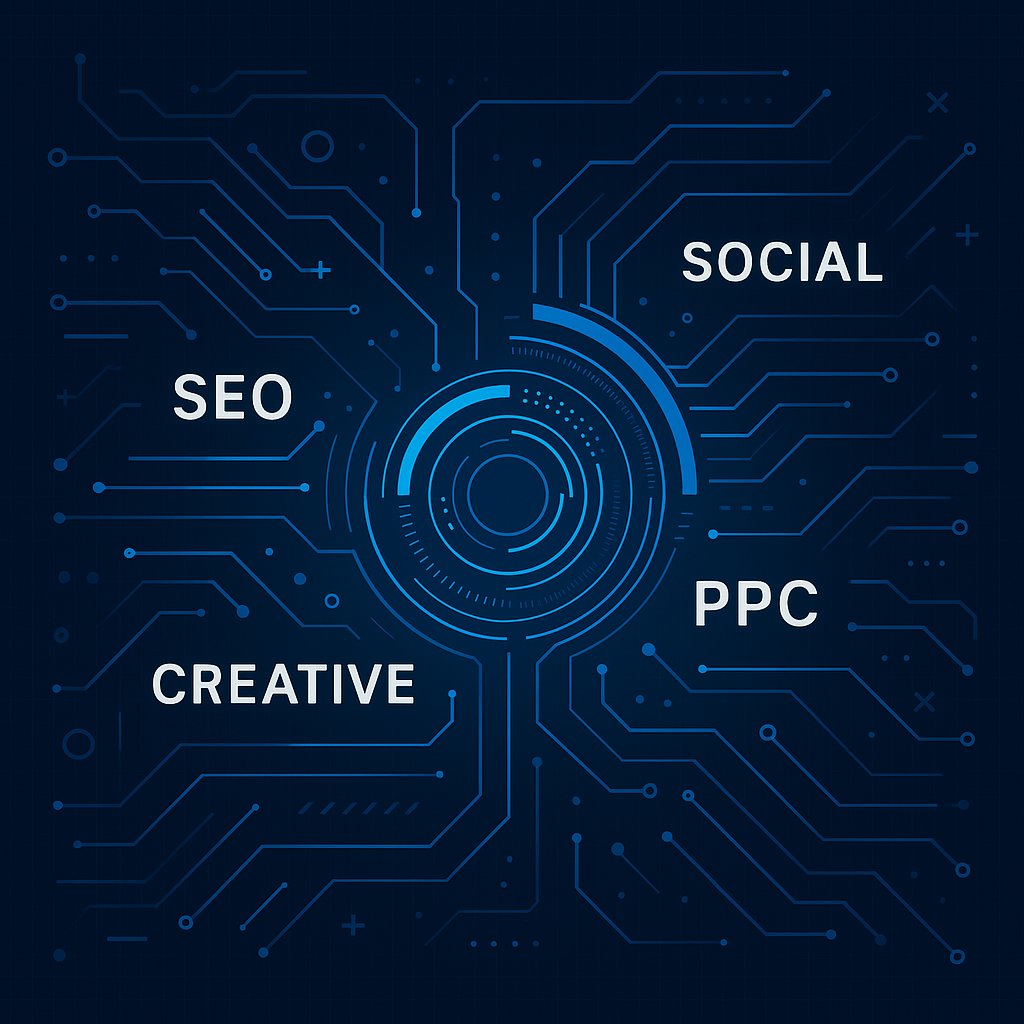
At Tandem Interactive, we treat these shifts as building blocks for growth. The work done in August reflects how each department, including search engine and AI optimization (SEO), pay-per-click marketing (PPC), organic and paid social, and our creative team, takes industry changes and turns them into actionable strategies for our clients. This monthly recap highlights not just what changed, but how those changes will shape more effective digital marketing in the future.
Inside Tandem Interactive: August in Review
This month, the search engine optimization (SEO) team looked at how accessibility affects rankings. They also discussed the rise of AI-generated content. Finally, they examined Google’s worldwide launch of AI Mode.
PPC teams used new Performance Max controls from Google. They improved remarketing with Microsoft Advertising. They also looked at the latest trends in automation and bidding.
Social and Creative teams kept up with new platform features. They adapted to Instagram’s engagement tools, TikTok’s creator guidelines, and Adobe Photoshop’s latest design tools.
Taken together, these updates show how digital marketing has integrated far more than in the past. Progress in one area creates chances in another. August showed us that integration is the key to lasting success.
SEO Insights: Accessibility, AI Content, and Google’s Global Expansion
August brought important changes in the SEO world. These changes included industry research and platform updates. They aim to help our clients reach the top of search engine results pages (SERPs).
Semrush published a large-scale study examining over 10,000 websites to understand how accessibility connects to SEO performance. The findings showed a strong correlation between higher accessibility scores and stronger organic outcomes, including traffic, keyword visibility, and Authority Score.
For SEO teams, this reinforces that accessibility is not just about compliance or user experience. It also supports search visibility.
Ensuring websites are usable by people of all abilities can directly influence rankings and engagement. Accessibility is becoming a measurable SEO factor, and building it into development plans is no longer optional.
To find out how much AI-generated text is online, Ahrefs looked at 900,000 new web pages from April 2025. Using their own detection approach, the Ahrefs team found that 74.2 percent of those pages contained AI-generated content. For SEO teams, that scale confirms the use of AI in written materials is significantly increasing.
These findings also reinforce the need for strong editorial standards, originality, and helpfulness as AI content becomes more common. Marketers cannot depend only on AI tools. They need human oversight because quality and trust are key to visibility and engagement.
Meanwhile, Google announced an important update to its AI Mode in Search. Rolled out to more than 180 countries, AI Mode now incorporates new agentic features such as booking capabilities and deeper personalization.
This global expansion shows how quickly AI-driven search is becoming part of everyday user behavior. For SEO experts, it is important to optimize for answer engines and conversational AI. This is just as crucial as focusing on traditional search results. Structuring content to be retrievable and clear in these new contexts is becoming a necessity, especially as AI surfaces content differently than classic rankings.
Together, these updates show the evolving balance between technical foundations, like accessibility, content production trends driven by AI, and shifts in search technology itself. SEO professionals who prioritize inclusivity, maintain editorial integrity, and adapt to new AI-driven discovery models will be better positioned as the industry continues to transform.
Social and Creative Highlights: Photoshop’s Star Tool, Instagram’s Repost Features, and TikTok’s Creator Guidelines
August brought meaningful updates across creative tools and social platforms, giving marketers and designers new ways to connect with audiences.
Adobe Photoshop introduced a notable addition in its August desktop release. Version 26.10 unveiled a new Star tool, which allows users to draw and customize star shapes directly on the canvas. Designers can now adjust points, radii, and styling in real time, making it easier to produce consistent graphics for campaigns, templates, and branded assets. Though simple, the tool reflects Adobe’s ongoing focus on streamlining creative workflows.
Instagram also rolled out a trio of new features aimed at fostering engagement. Users can now repost public Reels and posts, a move that mirrors functionality on competing platforms. The new Map feature displays tagged locations, helping people discover content in specific areas.
Another introduction from Instagram was a Friends tab in Reels, highlighting videos that friends have recently interacted with. These changes push Instagram further into discovery-driven and community-centered experiences, which may influence how brands shape their content strategies.
TikTok updated its creator guidelines, adding rules that reflect the platform’s evolving priorities. LIVE content received new oversight, clarifying what creators can and cannot stream. TikTok also included guidance on the use of AI-generated material, acknowledging the growing role of AI in content creation.
These updates, though subtle, send a signal to creators and brands that TikTok intends to balance innovation with responsibility while keeping user trust at the forefront.
These developments show how creative software and social networks continue to converge. Tools like Photoshop refine production, while platforms such as Instagram and TikTok adjust distribution and engagement.
For marketers, staying informed about both sides of this equation is essential, since the way content is created and the way it circulates are increasingly intertwined.
PPC Updates: Performance Max Controls, Microsoft Remarketing, Smart Bidding Strategies, and 2025 PPC Trends
August was an active month for paid search and advertising, with updates from Google and Microsoft. This, paired with fresh industry research on bidding strategies and long-term trends, will help Team Tandem to get your clients to your landing page and increase your conversion rate.
Google Ads rolled out new tools for Performance Max campaigns that give advertisers more precision and control. Shared negative keyword lists can now be applied across multiple campaigns, reducing wasted spend. The limit for search themes was increased from 25 to 50, providing broader coverage while still allowing customization.
Google also introduced demographic targeting refinements, enhanced new customer reporting, and AI-powered image recommendations. These changes show Google’s ongoing effort to balance automation with advertiser control, a balance that PPC professionals have been requesting since the launch of Performance Max.
Microsoft Advertising followed with its own slate of August updates. Impression-based remarketing lists can now be built across up to 20 campaigns or ad groups, a valuable addition for brands seeking to stay top-of-mind with audiences.
In addition, Microsoft introduced lifetime budget options for Audience ads, improvements to the Audience Planner for native campaigns, and more granular mobile app-level reporting in publisher reports. For advertisers seeking alternatives to Google, Microsoft continues to expand its toolkit with features that support efficiency and reach.
Outside of platform updates, PPC Hero published a detailed guide to maximizing ROI with smart bidding. The piece emphasized how automated bidding strategies, when monitored and adjusted carefully, can drive stronger returns by aligning bids with real-time signals such as device, location, and audience intent. For practitioners, the key takeaway is that automation should be embraced, but only with regular oversight and strategy adjustments.
Finally, broader PPC trends were highlighted in an August report from BloggerOutreach. The top five include deeper reliance on AI-powered automation, a growing emphasis on privacy and first-party data, emerging opportunities in voice search advertising, the continued rise of Amazon as a PPC channel, and stronger integration between SEO and PPC campaigns. These trends underline how paid advertising is no longer siloed but increasingly intertwined with broader digital strategies.
All of these developments reflect a PPC environment that is both highly automated and highly dynamic. Advertisers who adopt new platform tools, stay alert to shifts in targeting and privacy, and use automation strategically will be positioned to capture stronger results as 2025 unfolds.
Looking Ahead: From August Updates to Lasting Impact
Our August digital marketing insights underline an important truth. Strong digital marketing comes from anticipating change and moving with intention. This month’s SEO findings, social and creative rollouts, and PPC advancements show how each discipline supports the others, whether through technical accessibility, platform features, or smarter bidding strategies.
At Tandem, we see these updates not just as news but as opportunities. Aligning your SEO, social, creative, and paid campaigns ensures your brand can adapt quickly and connect meaningfully with your audience. The right mix of insights and execution turns complexity into clarity and change into results.
If you’re ready to translate August’s momentum into long-term growth, our team is here to help. Reach out today or explore more of our insights to see how an integrated digital strategy can move your business forward.
Sources:
Ahrefs:
https://ahrefs.com/blog/how-to-detect-ai-generated-content/
Google:
https://blog.google/products/search/ai-mode-agentic-personalized/
Adobe Photoshop Updates – August 2025:
https://helpx.adobe.com/photoshop/using/whats-new/2025-8.html
Instagram Newsroom – August 2025:
https://about.fb.com/news/2025/08/new-instagram-features-help-you-connect/
TikTok Guidelines Update – August 2025:
https://techcrunch.com/2025/08/15/tiktoks-new-guidelines-add-subtle-changes-for-live-creators-ai-content-and-more/
Google Ads Help Center – August 2025 Performance Max Updates:
https://support.google.com/google-ads/announcements/9048695?hl=en
Microsoft Advertising Blog – August 2025 Updates
https://about.ads.microsoft.com/en/blog/post/august-2025/impression-based-remarketing-updates-and-other-product-news-for-august
PPC Hero – Smart Bidding Guide, August 24, 2025:
https://www.ppchero.com/maximizing-roi-with-smart-bidding-a-guide-for-ppc-marketers/
BloggerOutreach – PPC Trends 2025:
https://www.bloggeroutreach.io/blog/ppc-trends