US MED is a medical supply company serving the entire United States and has served over 1 million satisfied customers since 1996. Products offered by US MED include continuous glucose monitors, insulin pumps, blood glucose test strips, CPAP supplies, and medications. Tandem’s focus for US MED’s PPC marketing is the continuous glucose monitoring products offered by US MED.

THE CHALLENGE: Increasing Landing Page Conversion Rates
All landing pages provide visitors with information about the product they’re searching for as soon as they land on the page. The headline tells them the product’s Unique Value Proposition, the copy gives them information about how the product works and how they will benefit from it, testimonials/award badges provide social proof, and the Call-to-Action tells them what to expect next.
The landing page form, however, doesn’t give visitors anything. Instead, it asks them for something – their personal information. This fact, combined with the length of long forms, can give way to conversion friction, a digital marketing term that refers to any part of the conversion process that makes a user less likely to convert.
THE SOLUTION: Multi-Step Forms
Visitors can easily be overwhelmed by seeing a long form on a landing page asking for too much information all at once, causing them to abandon the page. Multi-step forms help solve this problem by asking users to enter their information in multiple small steps instead of all at once.
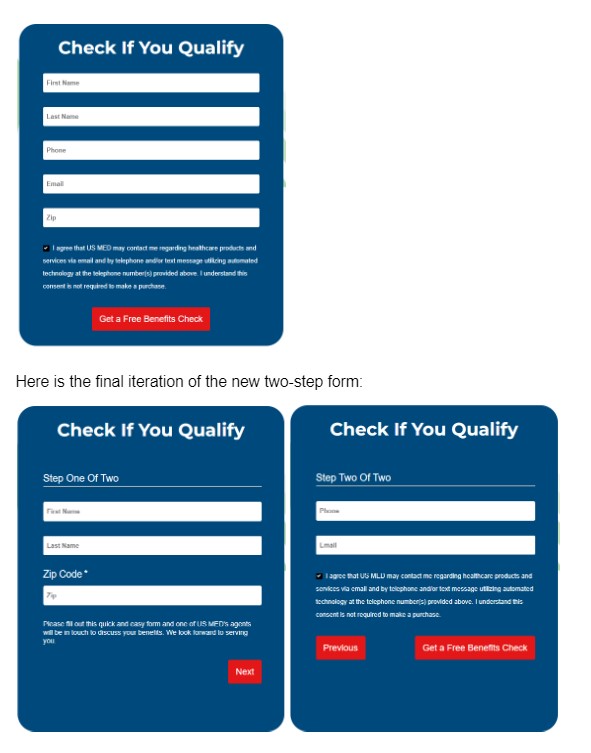
US MED’s lead form asked users for their first name, last name, phone number, email address, and zip code all at once. We decided to break this up into two steps and test to see if the rate at which users complete the form would increase. In the first step, the user was only asked for their name and zip code, while the second step asked for their phone number and email address.
We decided to ask for less personal information on the first step as we felt users would be more likely to provide contact information on the second step after they had already begun the process by giving us information that was less personally identifiable.
Below is the original form:
The Results:
The test went through several iterations before we found a version of the two-step form that converted at a higher rate than the original form.
These iterations were:
- The first iteration asked for only the zip code on the first step and the user’s name, email address, and phone number on the second step. It also featured a progress bar to let the user know how much of the form had been completed. In this test, the original produced 27% more conversions than the two-step form. With this information, we hypothesized that asking for four pieces of information on the second step after only asking for one (zip code) on the first step may have been a bit jarring for users, resulting in a lower conversion rate.
- For the second iteration, we decided to ask the user for their first name, last name, and zip code on the first step. In the second step, we asked for their phone number and email address. We also removed the progress bar. In this test, the original continued to perform better, though only slightly. The original form produced 3.3% more conversions than the two-step form.
- For the third iteration, we added the text “Step 1 of 2” and “Step 2 of 2,” respectively, to the first and second steps of the form. We did this to let users know what step they were on and how many total steps there were in the form. In this test, the two-step form generated 9.6% more conversions than the original form. We concluded that this version of the two-step form led to more conversions than the original and decided to place this form on all of US MED’s landing pages.
IN SUMMARY
This experiment showed us that breaking up a lead form into multiple steps can be an easy way to increase landing page conversions. This can even be true for forms such as those used by US MED, which does not ask for much information from the user.