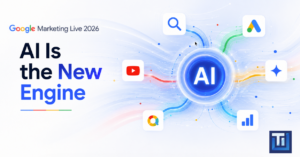
 Google Marketing Live 2026 made one thing very clear. AI is no longer a side feature in digital marketing. It is becoming the engine underneath search, advertising, creative, measurement, shopping, and lead generation.
That may sound like a big statement, but I do not think it is an exaggeration. Google’s announcements centered on Gemini-powered advertising, AI Mode in Search, Ask Advisor, AI Max, Demand Gen, Asset Studio, and new measurement tools designed to help marketers act faster and with better information.
For businesses, the takeaway is simple. The tools have changed because consumer behavior has changed. People are searching, comparing, asking questions, and making decisions in different ways than they did even a few years ago.
At Tandem, we have been preparing for this shift for a while. We are an AI-native online marketing agency. That does not mean we use AI as a shortcut. It means we build AI into the way we think about SEO, PPC, social, creative, analytics, content, and client strategy.
Search Is Becoming More Conversational
People are not only typing short keyword phrases anymore. They are asking bigger questions. They want help choosing, comparing, planning, and deciding. Google’s AI-powered Search updates are built around that behavior, with new ad formats designed to provide more helpful answers inside AI Mode and other search experiences.
For years, marketers could focus heavily on ranking for exact keywords. Keywords still matter, but the strategy has to grow beyond that. What happens if someone searches “How do I choose the right moving company?” or “What is the best way to compare digital marketing agencies?” They are not looking for a keyword-stuffed page. They are looking for guidance.
That is where content quality, structure, and usefulness become even more important. Websites need to answer real questions clearly. They need organized service pages, strong FAQs, helpful blog content, and information that AI systems can understand. This is not just about ranking in traditional search results, but about being ready for AI-assisted discovery.
AI Does Not Eliminate Strategy
It would be easy to come away from Google Marketing Live 2026 thinking Google is moving toward a fully automated marketing system where the platform handles campaign setup, bidding, creative, optimization, and reporting.
That is partly true. Google is building tools that can automate more campaign setup, bidding, creative generation, optimization, and reporting. Google’s Ask Advisor, for example, is being positioned as a cross-product AI agent that works across Google Ads, Google Analytics, Google Marketing Platform, and Merchant Center.
Ask Advisor could be useful, but it is not a replacement for knowing what you are doing. AI can recommend a campaign structure, but a strategist still needs to know whether the campaign makes sense for the business. AI can generate ad variations, but a creative team still needs to know whether the message fits the brand. AI can identify opportunities, but an experienced marketer still needs to decide whether those opportunities are worth pursuing.
The human role is changing. It is becoming less about managing every manual task and more about making the right strategic decisions. That is a good thing for businesses that have the right team behind them.
AI Max Shows Where Paid Search Is Going
AI Max was another major theme. Google is expanding the ways advertisers can use AI to capture more search opportunities, guide messaging, and send users to the most relevant landing pages.
One feature that stands out is AI Brief, which lets advertisers guide AI Max using natural language. Marketers can give messaging guidelines, matching guidelines, and audience guidelines, then preview how the system may apply that direction before committing.
AI Brief is worth paying attention to because paid search is becoming less rigid. Search queries are more varied, more conversational, and harder to predict manually. A strong PPC strategy now depends on good data, clear landing pages, strong brand direction, and smart guardrails.
The businesses that win will not be the ones that blindly turn everything on. They will be the ones who know what to feed the system, what to monitor, and when to adjust.
Creative Is Becoming a Performance Lever
Creative has always mattered, but Google is making it easier to scale and test creative across Google Ads and YouTube.
Asset Studio is being updated to generate and refine assets using a brand’s marketing brief, guidelines, website, and goals. That can help businesses create more useful assets faster, but again, the input matters.
If your brand positioning is weak, AI will scale weak creative. If your offer is unclear, AI will produce more versions of an unclear offer. AI can help execute a strategy, but it will not magically create one for you.
Creative scale is valuable when it is connected to a strong message, clear goals, and a real testing plan.
YouTube Is Moving Deeper Into Performance Marketing
Google also highlighted Demand Gen updates for YouTube. The message was clear. YouTube is not only for awareness. It can also support discovery, consideration, and conversion when the creative, audience strategy, and measurement are aligned.
Those Demand Gen updates create an opportunity for brands that have treated YouTube as separate from performance marketing. In many cases, businesses should start thinking about YouTube more as they think about paid social, with tested hooks, different creative angles, audience signals, earlier trust-building, and measurement tied to future conversions.
Not every business needs to jump into every new YouTube feature immediately. But every business should be paying attention to how video, creators, and AI-assisted campaign tools are blending together.
Measurement Has to Get Better
As AI handles more of the campaign execution, marketers need better ways to understand what is actually working.
Google announced that Meridian, its open-source Marketing Mix Model, is coming into Google Analytics 360. The goal is to help businesses unify cross-channel data, measure causal performance, and forecast outcomes for smarter investment decisions.
Attribution has been messy for a long time. A customer may see a video, search the brand later, click a paid ad, visit the website, call the business, and convert days or weeks later. If your measurement setup only sees the final click, you are making decisions with incomplete information.
Better measurement does not mean chasing every number. It means building a system that connects marketing activity to business outcomes as clearly and as early as possible.
The Real Takeaway From Google Marketing Live
The details from Google Marketing Live matter, but the bigger picture matters more.
Google is moving toward an AI-native marketing ecosystem. Search is becoming more conversational, ads are becoming more adaptive, and creative can now be scaled and tested faster than before. Measurement is also becoming more predictive, which means campaign management will depend even more on good data, clear strategy, and smart human oversight.
For businesses, panic is the wrong response. Preparation is the right one.
Getting prepared means investing in better content, cleaner website structure, stronger creative, smarter paid media strategy, better data connections, and marketing partners who understand how all of these pieces work together.
AI is changing the tools, but it is not changing the need for strategy, experience, and good judgment. Businesses still need to understand their customers, build useful content, measure what matters, and make smart decisions with the data in front of them.
Tandem is focused on the balance between better AI tools and better human strategy. We are using AI to make better marketing decisions, not to replace the thinking behind them.
Ready to Build an AI-Ready Marketing Strategy With Tandem?
Tandem is a full-service digital marketing agency helping businesses grow through search engine optimization (SEO), pay-per-click marketing (PPC), paid and organic social media, and creative strategy and services. Our team combines human expertise with AI-native tools to help clients adapt, compete, and make smarter marketing decisions. Connect with Tandem online to discuss your next steps.